

What anxiety is about: A psychodynamic and ISTDP perspective on the meaning of anxiety

This article explores the psychodynamic perspective of anxiety. Although I acknowledge the value and utility of other perspectives and contributions, such as psychopharmacology and cognitive behavioural approaches, such perspectives on anxiety won't be discussed here. My concern is limited to the question of what anxiety itself is concerned with, or about. This question can be approached via Habib Davanloo’s clinical method and metapsychology. Davanloo was a Canadian psychiatrist who developed Intensive Short Term Dynamic Psychotherapy (ISTDP) from the 1960s onwards. ISTDP has continued to develop since then. I feel this ISTDP and psychodynamic perspective on anxiety, both as a theory and clinical method, have much to offer in the way of both understanding and treating anxiety.
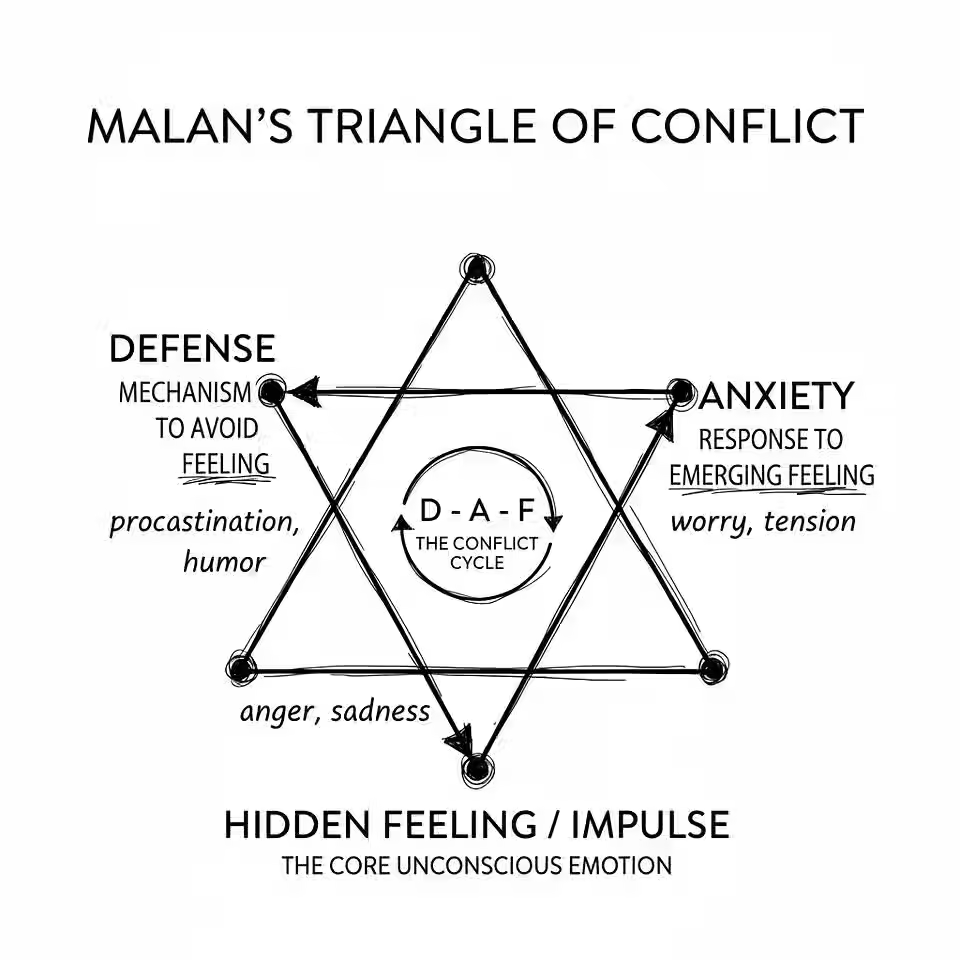
My central claim is that anxiety is a signal about an internal conflict. When core emotions that, for an individual, were hitherto unsafe or inappropriate for expression, the individual’s nervous system triggers anxiety as a warning signal to the individual that the expression or experiencing of such an emotion would cause them harm. Although the warning may once have been adaptive, the alarm can m continue sounding after the original danger has passed. In this sense, anxiety, once adaptive, can become a maladaptive signal of threat that has passed.

An ISTDP and psychodynamic perspective on anxiety
Psychodynamic perspectives offer a unique contribution by accounting for dynamic forces that exist within the person as an organism. I describe these mental states, such as emotions , as dynamic because they motivate or move us towards or away from. These mental states are about something. Philosophers call this quality of minds and mental states intentionality. In Brentano's sense, a mental state has intentionality when it is directed towards, is about, is for, or represents an object or state of affairs (Jacob, 2023). For example, the mental state of sexual arousal has intentionality because it is for or about sex. Moreover, anxiety, a mental state which itself has intentionality, is about something: being afraid of internal states. This differentiates anxiety from fear, which alerts the individual to external danger.
The psychodynamic contribution is that these dynamic forces can be conscious, partly unconscious, or wholly unconscious in that it is possible for a person to feel anxious but have no idea why they are or what they are anxious about. They can be more aware of the anxiety itself, a physiological response, it bodily alarm, than of the unconscious forces that set the alarm off. Moreover, for anyone that has experienced even mild anxiety, such states can be torturous and sufficient to convince the individual they are going mad or falling apart. Even if we don't know or cannot articulate what we are anxious about, anxiety has core emotions as its object. It is in this sense that anxiety is about something. Anxiety can thus also be called intentional in that it is about impulses, core emotions and internal conflicts we are trying to manage.
The danger of feelings and attachment trauma
There may be various types of unconscious forces that cause anxiety, or that anxiety is about, but here I will focus on core emotions such as rage, anger, grief, guilt, joy and longing. In relationships with early caregivers and attachment figures, we learn which of these emotions are acceptable and safe to express, and which are unacceptable and unsafe to express. Certain feelings, such as joy or sadness, may be met with responsiveness and curiosity. Others, such as rage, anger and guilt, may provoke punishment, neglect or hostility from their caregiver. Research supports the broader notion that these early relationships with caregivers shape how one responds to or experiences core emotions; either by allowing them to occur and pass as a fleeting state or by developing a fear and aversion of them, and becoming excessively anxious when the core feelings emerge towards consciousness (Cooke et al., 2019; Brumariu et al., 2025).
For example, if a child is repeatedly humiliated when they express anger, they may learn that anger is unacceptable: that expressing it towards an attachment figure risks rupture or further humiliation. That is how we tend to become afraid of core feelings, because we learn at an early age that for our caregivers to be responsive to us, some feelings are safe to express and others are not. Since children typically do not have the freedom to abandon a relationship with one of their primary caregivers, they usually must adapt and change themselves internally so that they can survive in relation to their caregivers. This survival may necessitate that the individual, to sustain the attachment relationship and avoid any severing of it, becomes phobic certain core emotions, such as anger, grief, guilt, or longing. This makes anxiety about the core emotions that couldn't be safely felt and expressed.
Anxiety as a warning signal due an update
The above account of anxiety, that it alerts the individual to internal danger, is consistent with Freud's concept of signal anxiety. This proposes that anxiety functions to warn and alter the ego to internal danger. By doing so, it also prompts defence mechanisms (Freud, 1926/1959). These defence mechanisms may have become necessary because the feared of not protecting oneself from such core emotions is to risk a rupture or severing of an essential attachment bond.
From this perspective, anxiety has what we might call acquired intentionality, in that it may point towards the previous danger of an earlier relational wound. This means anxiety is likely to signal when it was previously unsafe for an individual to express a certain emotion, yet they haven't had sufficient information to prove to them that it is now safe for the individual to relate to, experience, or express the emotion differently. For example, an adult who becomes anxious when they feel anger towards authority figures does so because the anxiety used to alert them to the risk of humiliation or harm inherent in expressing anger. However, since the danger may no longer be present even when they become anxious, the intentionality of their anger is mistaken or misdirected.The essence I am trying to extract this is that, from a particular psychodynamic perspective, anxiety is fundamentally about people being afraid of core emotions that at an earlier time could not be safely expressed or safely responded to.
Defences and the management of anxiety
If the individual does not have new, reparative experiences demonstrating to them that their once feared emotions are now acceptable, they develop ways of managing the anxiety associated with these emotions that can crystallise into behaviour and character. These protective behaviours and manoeuvres used to manage this anxiety are called character armour (Reich, 1933) or defences (Coughlin, 2026), and are things we do consciously or unconsciously to manage the anxiety that is generated by the core feelings we are afraid of.
It is fairly simple to see how this operates in everyday life in regular examples, such as apologising to someone who bumped into you on the tube. The point in this article isn't to account for the manifest ways that we can protect ourselves from core emotions through defences, but rather, to demonstrate how working with such defences, and tolerating the anxiety that emerges when such defences are relinquished, is likely a therapy specific factor in effective treatment.
The physiology of anxiety
From Davanloo’s perspective, anxiety is a physiological state that is a response to internal stimuli (e.g. core emotions). From this perspective, it is important for the therapist to observe and discern how much anxiety is present and how it is discharged in the body through one of three possible pathways. As a physiological state, anxiety can manifest at different degrees of severity, depending on whether the anxiety is mobilised in the striated muscles, smooth muscles, or by affecting one’s cognitive and perceptual apparatus. Going into too much detail on this may be excessively technical for the purposes of this article, but, broadly speaking, it is optimal for the purposes of treatment to keep (note the word keep, not eliminate), anxiety into the striated muscles, and avoid it manifesting into higher, more pathological levels in the smooth muscle and cognitive-perceptual pathways. Examples of physiological manifestations at these three levels are:
Striated muscle anxiety:
Tension headaches
Air hunger (dyspnea)
Skeletal muscular pain, tension, and problems (e.g. myofascial pain)
Smooth muscle anxiety:
Nausea
Gastrointestinal problems (e.g. acid reflux, stomach pain)
Nausea
Jelly legs
Trembling
Anxiety that disrupts the cognitive and perceptual apparatus:
Ringing in the ears (tinnitus)
Depersonalisation and derealisation
Tunnel vision
Mind going blank
Pseudoseizures
Knowing how anxiety is channeled in an individual helps the therapist judge whether the process needs to slow down and focus on anxiety regulation, or whether to pursue healing the individual access to the core emotions driving their anxiety. If anxiety is primarily channeled into striated muscles, such as when there is muscular tension but clear thinking, then further exploration or underlying emotional conflicts is likely to be fruitful.
On the other hand, symptoms of dissociation, confusion, tinnitus and a muffled sensation in the head all suggest the priority is to slow the process down and regulate anxiety first until it is primarily in the striated muscles. It is at this level that individuals remain in their zone of proximal development, where the task of learning to tolerate their anxiety and experience the underlying emotion is not too easy or too difficult, and one is able to learn from new, reparative experiences. Finally, it is these new reparative experiences that lead to actual full relief from anxiety. Once the repressed emotions have been felt, people often report feeling calmer, relaxed, and clearer-headed.
Psychodynamic therapy for anxiety
Although one may find full relief from anxiety once it is in the striated muscles and feelings are accessible, it is not entirely accurate to say that the point of psychotherapy is to eliminate anxiety. Rather, anxiety should be kept within a range tolerable enough that you have access to the range of core emotions driving your anxiety.Also, anxiety should remain in the striated muscles in form of sighing, hand clenching, jaw biting, tension headaches or muscular tension, and anxiety avoids being channelled into the smooth muscle or cognitive perceptual pathway When these conditions are met, you can safely access the core emotion and anxiety is no longer necessary. When this occurs, two kinds of learning become possible:
1. This anxiety can be uncomfortable without necessarily proving that I am in danger
.2. The core emotions that generate this anxiety can now be safely experienced and expressed
In psychodynamic therapy for anxiety, equal attention must be paid to the underlying or manifest core emotions and also level and severity of anxiety, to ensure that the treatment is not iatrogenic and that the experiencing of core emotion leads safe and sustained anxiety and symptom relief. Through the experiencing of core emotions that are, primarily, about attachment, such as grief, rage, anger, guilt, love and longing, you can discover that the experiencing of the emotion, and of the wishes and impulses the emotion is about, is not the same as deed (i.e. it is possible to feel murderous rage towards a caregiver and, inside the rage, want to murder them, without actually wanting to or seriously considering this.. It is only when the individual can, at an experiential level, make this distinction between the wish and deed, that one learns the underlying core emotions are just feelings, and that there is no longer any need to become anxious about them. In this lessening anxiety, the individual can also relinquish their once adaptive defences.
References and Sources
Abbass, A., Town, J.M. and Driessen, E. (2012) “Intensive Short-Term Dynamic Psychotherapy: A systematic review and meta-analysis of outcome research”, Harvard Review of Psychiatry, 20(2), pp. 97-108. doi: 10.3109/10673229.2012.677347.
Abbass, A. and Town, J.M. (2025) “Intensive Short-Term Dynamic Psychotherapy for complex, chronic, and treatment-resistant conditions”, American Journal of Psychotherapy. doi: 10.1176/appi.psychotherapy.20240024.
Brumariu, L.E., Nair, T.K., Waslin, S.M., Rodrigues, G.A., Moore, M.T. and Kerns, K.A. (2025) “Parental emotion socialization and internalizing problems in childhood and adolescence: A meta-analytic review”, Development and Psychopathology, pp. 1-21. doi: 10.1017/S095457942510059X.
Cooke, J.E., Kochendorfer, L.B., Stuart-Parrigon, K.L., Koehn, A.J. and Kerns, K.A. (2019) “Parent-child attachment and children’s experience and regulation of emotion: A meta-analytic review”, Emotion, 19(6), pp. 1103-1126. doi: 10.1037/emo0000504.
Davanloo, H. (1990) Unlocking the Unconscious: Selected Papers of Habib Davanloo, MD. Chichester: Wiley.
Freud, S. (1926/1959) “Inhibitions, symptoms and anxiety”, in Strachey, J. (ed. and trans.) The Standard Edition of the Complete Psychological Works of Sigmund Freud, Volume XX. London: Hogarth Press, pp. 75-175.
Freedman, J. (2026) ‘What is Psychodynamic Therapy?’. (Accessed: 30 September 2026).
Jacob, P. (2023) “Intentionality”, in Zalta, E.N. and Nodelman, U. (eds.) The Stanford Encyclopedia of Philosophy. Available at: https://plato.stanford.edu/entries/intentionality/ (Accessed: 20th September 2026).
Maroti, D., Hasselgren, E., Vallhagen, V., Hellgren, J., Lilliengren, P. and Johansson, R. (2025) “Anxiety pathways in ISTDP: Self-reported symptom clusters in patients with persistent physical symptoms”, Journal of Contemporary ISTDP. doi: 10.70839/5sgny662.
Comments